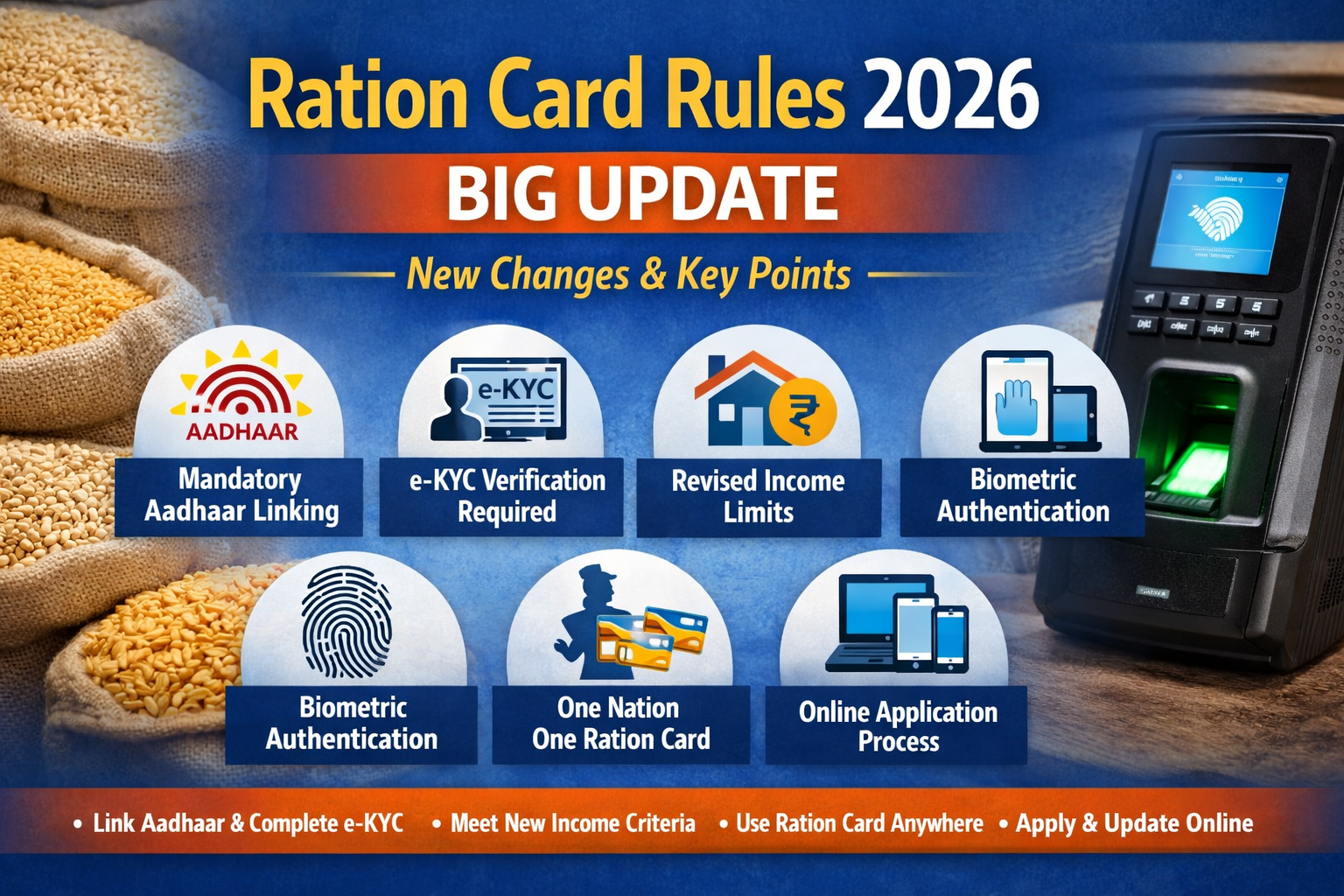
Ration Card Rules 2026 Big Update:The Government of India has introduced major updates in the ration card system for 2026 to ensure transparency, eliminate duplicate beneficiaries, and strengthen the Public Distribution System (PDS). These new rules aim to provide benefits only to genuinely eligible families while promoting digital verification and nationwide portability.
This detailed guide explains the Ration Card Rules 2026, including new eligibility criteria, income limits, mandatory Aadhaar linking, e-KYC requirements, One Nation One Ration Card implementation, online application process, document requirements, cancellation rules, and penalties.
Introduction to Ration Card System in India
The ration card is an essential government document issued by state governments under the National Food Security Act (NFSA). It enables eligible households to receive subsidized food grains such as rice, wheat, and coarse grains through fair price shops.
The ration card also serves as identity and residence proof and is often required for government schemes, scholarships, LPG connections, and welfare benefits.
Why Ration Card Rules Are Changing in 2026
Over the years, multiple issues such as fake ration cards, duplicate beneficiaries, income misreporting, and improper targeting of subsidies have created financial burdens on the government.
To address these concerns, the Government of India, under the National Food Security framework, has introduced stricter digital verification, income validation, Aadhaar authentication, and nationwide portability reforms in 2026.
Major Highlights of Ration Card Rules 2026
- Mandatory Aadhaar linking for all family members
- Compulsory e-KYC verification
- Revised income limits for eligibility
- Strict action against ineligible beneficiaries
- Biometric authentication at ration shops
- Strengthened One Nation One Ration Card portability
- Complete digitization of application and update process
Mandatory Aadhaar Linking in 2026
Under the new rules, linking Aadhaar with ration card has become mandatory for every member listed in the family card.
If Aadhaar is not linked within the specified timeline, ration benefits may be suspended until verification is completed.
The objective is to eliminate duplicate entries and ensure that only genuine beneficiaries receive subsidized food grains.
How to Link Aadhaar with Ration Card
- Visit your state food department portal
- Enter ration card number
- Provide Aadhaar details of all family members
- Verify through OTP or biometric authentication
- Submit and download confirmation receipt
e-KYC Mandatory for All Beneficiaries
Electronic Know Your Customer (e-KYC) verification is compulsory in 2026. Every ration card holder must complete biometric authentication through Aadhaar-based verification.
Failure to complete e-KYC may lead to temporary suspension or cancellation of ration benefits.
Where to Complete e-KYC
- Fair price shop (FPS) with biometric device
- Common Service Centers (CSC)
- State food supply office
Revised Income Limits in 2026
The government has introduced updated income thresholds to better target economically weaker families.
Families whose annual income exceeds the prescribed limit may become ineligible for subsidized ration benefits.
General Income Criteria (Indicative)
- Urban areas: Income limit revised as per state guidelines
- Rural areas: Separate income criteria applicable
- Ownership of certain assets may disqualify applicants
Exact limits may vary by state government notification.
Asset-Based Disqualification Rules
Under the new 2026 guidelines, households owning certain assets may be excluded from eligibility:
- Four-wheeler vehicles (except commercial vehicles)
- Large agricultural land beyond defined limits
- Government employees in certain pay grades
- Income taxpayers
One Nation One Ration Card (ONORC) Strengthened
The One Nation One Ration Card scheme allows beneficiaries to lift food grains from any fair price shop across India.
In 2026, this system has been further strengthened with real-time biometric authentication and integrated national database verification.
Migrant workers benefit significantly from this portability system.
Biometric Authentication at Ration Shops
To prevent fraud and ghost beneficiaries, biometric authentication through fingerprint or iris scan is mandatory during ration distribution.
If biometric authentication fails, alternate OTP-based verification may be allowed as per guidelines.
Online Application Process for New Ration Card in 2026
The application process has been fully digitized to improve transparency and reduce manual errors.
Step-by-Step Process
- Visit the official state food and civil supplies department website
- Register using mobile number
- Fill application form with family details
- Upload required documents
- Submit application
- Track status online
Documents Required for New Application
- Aadhaar card of all family members
- Proof of residence
- Income certificate
- Passport-size photographs
- Mobile number linked with Aadhaar
Ration Card Categories
Different categories continue to exist under NFSA:
- Priority Household (PHH)
- Antyodaya Anna Yojana (AAY)
- Above Poverty Line (APL) – as per state policy
Penalties for False Information
Providing false income details or hiding assets can lead to:
- Immediate cancellation of ration card
- Recovery of wrongly availed benefits
- Legal action under relevant provisions
How to Check Ration Card Status Online
Applicants can track their ration card application status through:
- State food department portal
- Using ration card number
- Using Aadhaar number
Correction and Update Process
Beneficiaries can update:
- Address changes
- Add or remove family members
- Correct name spelling
- Update mobile number
Updates can be done online or at designated offices.
Important Deadlines in 2026
State governments may announce specific deadlines for Aadhaar linking and e-KYC completion. Beneficiaries are advised to complete verification before the notified cut-off date.
Benefits of New Ration Card Rules 2026
- Better targeting of subsidies
- Reduced fraud and duplicate cards
- Increased transparency
- Nationwide portability
- Faster online services
Impact on Existing Beneficiaries
Existing ration card holders must ensure:
- Aadhaar linking completed
- e-KYC verified
- Income details accurate
- Mobile number updated
Failure to comply may result in temporary suspension.
How Migrant Workers Benefit
Migrant laborers can now access ration from any state without transferring their card permanently, thanks to improved ONORC integration.
Common Reasons for Ration Card Cancellation
- Duplicate ration cards
- Fake documentation
- Income exceeding eligibility limit
- Death of primary cardholder without update
Appeal Process in Case of Cancellation
If your ration card is wrongly cancelled, you may:
- Submit written application to food supply officer
- Provide supporting documents
- Request review within prescribed timeline
Conclusion
The Ration Card Rules 2026 represent a major reform in India’s food subsidy system. With mandatory Aadhaar linking, e-KYC verification, revised income limits, and strengthened nationwide portability, the government aims to ensure that food security benefits reach the most deserving households.
All beneficiaries are advised to complete their verification process, update documents, and stay informed through official state portals to avoid interruption in benefits.

તેમણે વર્ષ 2019 માં Veer Narmad South Gujarat University (VNSGU) થી Master of Arts પૂર્ણ કર્યું છે. તેમને માહિતી આધારિત લેખન કરવાનો રસ છે. તેઓ MahitiPatrika.Com પર સરકારી ભરતી, ખાનગી નોકરી, સરકારી યોજનાઓ, એડમિટ કાર્ડ, કોલ લેટર અને પરિણામ સંબંધિત માહિતી ઓફિશિયલ સોર્સ પરથી ચકાસી ને સરળ ગુજરાતી ભાષામાં રજૂ કરે છે.